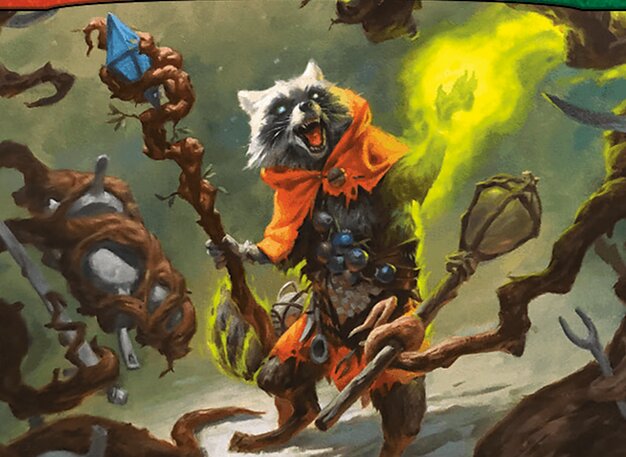
// Custom deck · Bello, Bard of the BramblesAnimated Army
Bracket
B4
// Navigate
Custom deck · B4Animated ArmyBello, Bard of the Brambles
// Sign in
↑↓ navigate↵ openesc close
Bello, Bard of the Brambles · Bracket 4 · Gruul animated artifacts
ANIMATEDARMY. eighteen of them.
Bello turns eighteen of your artifacts and enchantments into 4/4 indestructible attackers that draw a card when they connect, and only on your own turn.
Three lands covering RG, castable ramp and a qualifying permanent; Ring alone does not fix colors.
Develop
Ramp, cast Bello when an attacker or enter payoff is ready, and protect the commander.
Finish
Count actual unblocked combat damage; Mantle makes power, or mana only with a qualifying positive-mana source.
Watch out
Bello is vulnerable; removal ends animation. One Ring and crewed Chariot have their own exceptions.
Guide reviewed · List 0d9c258a
Rules and list review, not a playtest record. Turn windows and matchup advice are estimates. The list reference covers card quantities and the command zone; card changes require another guide and pod-note review.
Bello, Bard of the Brambles turns eighteen of your artifacts and enchantments into 4/4 indestructible hasty creatures that draw a card when they connect, and only during your own turn.
Full gameplan
Everything follows from one line of his text box: mana value 4 or greater, not an Equipment, not an Aura. The best thing the deck does runs forward rather than backward: a qualifying permanent cast on your turn with Bello already out enters already a 4/4 creature, so Warstorm Surge, The Great Henge, Garruk's Uprising, Outcaster Trailblazer and Garruk's Packleader all fire off a mana rock. Two Game Changers, Ancient Tomb and The One Ring. One unbounded loop, Umbral Mantle on a rock that taps for three, disclosed before the shuffle. No nonland tutors, one conditional counterspell in Null Elemental Blast, no extra turns.
Opening hands
Seven cards from this build. Commanders start in the command zone. In multiplayer Commander, the first mulligan is free. For later mulligans, draw seven again; once you keep, put one card on the bottom for each mulligan beyond the free one.
KeepShow the seven
Forest
Mountain
Command Tower
Llanowar Elves
Arcane Signet
Esika's Chariot
Heroic Intervention
T1 Forest into Elves; T2 Mountain supports Bello from the command zone; T3 Tower and your mana can deploy Chariot or retain protection. Both colors are available for the first casts.
BorderlineShow the seven
Forest
Mountain
Arcane Signet
Mind Stone
Garruk's Uprising
Thran Dynamo
Beast Within
Two lands cast a T2 rock, but missing land three delays animation and protection. Keep at a slower table; use the first free mulligan to seek three lands against early pressure.
MulliganShow the seven
Forest
Sol Ring
Gilded Lotus
Warstorm Surge
Unnatural Growth
Bootleggers' Stash
Crackle with Power
Ring alone does not supply red or another land. This hand has expensive payoffs without reliable colored development; ship even though Ring is present.
Bello, Bard of the Brambles strategy guide
Pace and examples. Turn windows below are author estimates and illustrative sequences, not measured multiplayer results or guarantees. A first opponent eliminated is not a whole-table win. In multiplayer the first mulligan is free; later mulligans follow the London procedure. The commander starts in the command zone, outside the seven-card examples.
Animated Army runs Bello, Bard of the Brambles ({1}{R}{G}, a 3/3 Legendary Creature, Raccoon Bard), and the deck is one sentence of his text box: “During your turn, each non-Equipment artifact and non-Aura enchantment you control with mana value 4 or greater is a 4/4 Elemental creature in addition to its other types and has indestructible, haste, and ‘Whenever this creature deals combat damage to a player, draw a card.’” Read the qualifiers, because every one of them cuts. During your turn and nobody else’s. Non-Equipment, which excludes three cards here by name whatever they cost. Non-Aura, which costs this deck nothing because it runs no Auras. And mana value 4 or greater, the line that sorts thirty cards into eighteen that turn on and twelve that never do. He is a 3/3 with no protection of his own, and the moment he leaves the battlefield every animated attacker stops being a creature and is removed from combat (CR 506.4). Protect him accordingly.
What the deck is doing
On your turn you have a dozen indestructible hasty 4/4s that each draw you a card when they connect. On everyone else’s turn you have a pile of mana rocks and enchantments and almost no creatures at all. That asymmetry is the deck, and it decides which removal can touch you and when.
On your turn, damage sweepers do nothing to the eighteen, because Bello gives them indestructible. Edicts, sacrifice effects and exile still work, and so does anything aimed at Bello himself.
On an opponent’s turn, creature removal and creature sweepers cannot see the eighteen at all, unless another effect makes one a creature, such as crewing Esika’s Chariot. Bello’s indestructibility is absent, but printed indestructible on The One Ring remains. Artifact and enchantment answers are the usual threats.
The deck has no nonland tutors and one conditional counterspell, Null Elemental Blast. Nothing in the ninety-nine searches your library for a nonland card. What it has instead is draw, eleven cards of it: The One Ring, The Ten Rings, The Great Henge, Garruk’s Uprising, Outcaster Trailblazer, Garruk’s Packleader, Shamanic Revelation, Hedron Archive, Mind Stone, Big Score and Sensei’s Divining Top, plus Bello’s own granted trigger on every animated permanent that gets through. Outpost Siege on Khans adds an impulse card at each upkeep, which is a play, not a draw.
The eighteen
The deck runs eighteen artifacts and twelve enchantments outside its creature slots. Thirty cards, and Bello animates exactly eighteen of them: nine artifacts and nine enchantments, so the halves do not line up with the card types. Here they are by mana value, so you can check a line at the table without rereading thirty cards.
Mana value 9.The Great Henge.
Mana value 8.The Ten Rings.
Mana value 6.Bootleggers’ Stash, March of the World Ooze, Warstorm Surge.
Mana value 5.Berserkers’ Onslaught, Gilded Lotus, Gratuitous Violence, Rain of Riches, The Eternity Elevator, Unnatural Growth.
Mana value 4.Alchemist’s Talent, Alien Invasion, Esika’s Chariot, Hedron Archive, Outpost Siege, The One Ring, Thran Dynamo.
One, one, three, six, seven. Eighteen.
Twelve never animate, and the reason splits three and nine.
Three are Equipment, which Bello’s own text excludes by subtype whatever they cost: Lightning Greaves ({2}), Swiftfoot Boots ({2}), Umbral Mantle ({3}). The Mantle would miss twice over, since it is also only mana value 3.
Nine sit under mana value 4: Sol Ring (1), Sensei’s Divining Top (1), Burgeoning (1), Arcane Signet (2), Gruul Signet (2), Mind Stone (2), Talisman of Impulse (2), Beastmaster Ascension (3), Garruk’s Uprising (3).
Esika’s Chariot is the one that looks like an exception and is not. It is a Legendary Artifact, Vehicle, at mana value 4. A Vehicle is not an Equipment, so Bello animates it on your turn with no crew paid at all, and its printed 4/4 is the same size Bello sets anyway. Crew 4 still matters on an opponent’s turn, when nothing you own is animated: the Chariot and Raging Ravine are the two permanents you can switch on as blockers. Haywire Mite is the other near miss: it is an Artifact Creature, so it is already a creature, but at mana value 1 Bello was never going to touch it.
The bracket audit
Bracket 4Commander brackets: 1 Exhibition, 2 Core, 3 Upgraded, 4 Optimized, 5 cEDH. Assess Game Changers, intent, pace and disruptive patterns together., declared up front. The audit line by line.
Game Changers. Exactly two, and Bracket 4 has no cap: Ancient TombGC (Game Changer) and The One RingGC (Game Changer). No other card in the hundred is on the list.
Infinite combos. One engine, two shapes, both disclosed before the shuffle: Umbral Mantle attached to an animated permanent that taps for three mana. On Thran Dynamo, Gilded Lotus or The Eternity Elevator, all three of which tap for exactly three, it is unbounded power and no net mana. On The Eternity Elevator at twenty or more charge counters it is unbounded mana, and Crackle with Power turns that into a table kill.
Mass land denial. None.
Extra turns. None. Full Throttle and Great Train Heist add combat phases, not turns, and that distinction gets said out loud because it sounds identical across a table.
Tutors. None that find a nonland card. Six cards search the library and all six find lands: Farseek, Nature’s Lore, Rampant Growth, Sakura-Tribe Elder, Evolving Wilds, Terramorphic Expanse. Mosswort Bridge looks at the top four and hides one of them, which is selection rather than a search, and Sensei’s Divining Top reorders three.
Expected game length. First-elimination estimate: around turn six or seven from combat; a table win takes longer. These are untested estimates supporting a pregame conversation, not measured fit.
Mulligan
You need two things in the opener: a path to {1}{R}{G} on turn three, and at least one of the eighteen to point him at. A hand full of the twelve that miss is a hand with no deck in it.
Snap keeps.
Sol Ring with usable colored mana and action. Ring accelerates generic costs; keep only when the lands still cover red and green and the remaining cards develop the plan.
Three lands, mana to cast Bello from the command zone, and one of the eighteen. That is the curve the deck was built on.
Two lands, a green one-drop, and a four-drop.Birds of Paradise or Llanowar Elves into Bello on turn two, then the first 4/4 on turn three.
Ship back.
Lands plus only the twelve that miss. A grip of Arcane Signet, Gruul Signet and Sensei’s Divining Top ramps into nothing.
No green source. Green is the heavier half of the requirement: 44 green pips against 30 red across the sixty-four nonland cards.
Five or more lands with no action. You have 36 lands. You will find more.
Ghalta, Primal Hunger in the opener is a trap card. He is {10}{G}{G} and costs {X} less where X is the total power of creatures you control, which on turn one is zero. He is a payoff for a board that already exists, never a reason to keep.
A hand with the Umbral Mantle and none of Thran Dynamo, Gilded Lotus or The Eternity Elevator is a fair hand, not a combo hand. There is no tutor in the deck, so the second half is drawn or it is not. Keep it on the strength of the lands and the curve.
A four-drop with no Bello is still keepable; a Bello with no four-drop usually is not.Thran Dynamo, Hedron Archive and The One Ring all do their job as ordinary artifacts. Bello with nothing to animate is a 3/3 Raccoon.
The kill lines
Every line here needs Bello on the battlefield, and every one of them happens inside your own main phase and combat. Pick off what is already down rather than off what you hope to draw, because nothing in this deck goes and gets a card.
Wincon 1·the eighteen attack, and Gratuitous Violence doubles all of it
The default kill and the one you will use most games. Bello resolves, three or four of the eighteen are already on the battlefield, and they all attack as indestructible hasty 4/4s that each draw a card on connect. Nothing needs to be assembled. The multipliers stack on top, and most of them are themselves among the eighteen, which means they attack while they multiply.
Gratuitous Violence, mana value 5, doubles every point of damage your creatures deal.
Berserkers’ Onslaught, mana value 5, gives attacking creatures you control double strike, so each animated permanent hits twice and draws twice.
Unnatural Growth, mana value 5, doubles the power and toughness of each creature you control at the beginning of each combat.
March of the World Ooze, mana value 6, sets base power and toughness 6/6 instead of Bello’s 4/4 if it landed after him. Read the layers trap before you count on it.
Beastmaster Ascension, mana value 3 and not animated, needs seven quest counters. A seven-attacker board puts all seven on during one declare-attackers step, so the +5/+5 is live for that same combat.
Garruk’s Uprising, mana value 3 and not animated, gives the whole team trample. It is the only blanket evasion in the ninety-nine.
Goreclaw, Terror of Qal Sisma gives each creature you control with power 4 or greater +1/+1 and trample whenever he attacks, which is every one of the eighteen.
Domri, Anarch of Bolas is a static +1/+0 to creatures you control, which on your turn includes all of them.
Ouroboroid puts counters equal to its own power on each creature you control at the beginning of combat on your turn. At 1/3 that is one apiece, and it counts itself, so the number doubles every turn. Those counters stay on the permanents for good.
The One Ring is the standout attacker, because it can swing and tap for cards on the same turn. That line is written out in the traps below.
Four animated permanents at 4/4 is 16 damage a combat and 4 cards off Bello’s granted trigger.
With Gratuitous Violence: 32 damage.
With Berserkers’ Onslaught on top: 32 first strike plus 32 regular is 64 damage and 8 cards.
With Unnatural Growth doubling at the beginning of combat as well: 8/8s, so 128 damage through one combat.
Against one untouched opponent at 40, the bare 16-damage version needs three unblocked combats; the 32-damage version needs two. The 64- and 128-damage versions are lethal in one combat if enough damage reaches that player. Divide attackers and account for blockers before calling a table kill.
Wincon 2·Umbral Mantle on a rock that taps for three, unbounded power
Three cards: Bello, Umbral Mantle, and any one of Thran Dynamo, Gilded Lotus or The Eternity Elevator. The order inside the loop is forced, and getting it backwards is the most common way to lose the line.
Bello is on the battlefield and it is your turn, so Thran Dynamo is a 4/4 Elemental with haste and indestructible.
Attach the Umbral Mantle for its Equip {0}. Equip means attach to target creature you control, activate only as a sorcery (CR 702.6a), so this only ever happens in your own main phase with the stack empty, and only while the rock is a creature.
Tap the Dynamo for {C}{C}{C} first. The Mantle grants “{3}, {Q}: This creature gets +2/+2 until end of turn.” The {Q} is the untap symbol, and a permanent that is already untapped cannot be untapped to pay it (CR 107.6), so a fresh untapped rock cannot start the loop.
Activate the granted ability. The three colorless you just floated pays the {3}, because generic costs can be paid with any type of mana (CR 107.4b), and mana stays in your pool until the end of the step or phase (CR 106.4), so nothing is lost between the tap and the activation.
The Dynamo is untapped and two bigger. Go back to step 3.
Each cycle is mana neutral and +2/+2. Bello sets base power and toughness 4/4 in layer 7b and the Mantle modifies in layer 7c (CR 613.4b, CR 613.4c), so N cycles gives you a rock that is 4 plus 2N in both boxes. Gilded Lotus is the identical loop in color, since it taps for three mana of any one color and the {3} takes any of it. The Eternity Elevator is the third carrier, off its printed “{T}: Add {C}{C}{C},” which it has at any counter count.
Two rocks look like they loop and do not. Hedron Archive taps for {C}{C} and The Great Henge taps for {G}{G}, so each cycle costs a mana. They pump twice off a full pool and then stop.
Haste is doing real work here. A rock you cast this turn has not been under your control since the turn began, so the summoning sicknessA creature cannot attack, and cannot activate an ability with the tap or untap symbol in its cost, unless it has been under its controller's control continuously since their most recent turn began (CR 302.6). Haste turns it off, and it never applies to other permanent types. rule would block both its own tap ability and the Mantle’s untap symbol (CR 302.6). Bello grants haste, which lifts exactly that restriction for both (CR 702.10c).
The limits, said out loud. The loop only exists during your turn, because that is the only window in which a rock is a creature. The +2/+2 is until end of turn and resets every cleanup. And the Mantle falls off and has to be re-attached, which costs nothing but is sorcery speed. A giant indestructible attacker still has to connect: Garruk’s Uprising or an attacking Goreclaw, Terror of Qal Sisma supplies the trample.
N cycles on Thran Dynamo gives a 4 plus 2N body, at zero net mana per cycle.
18 cycles is a 40/40, which is one opponent from 40 with trample and nothing else.
With Gratuitous Violence: 9 cycles is a 22/22 hitting for 44.
With Berserkers’ Onslaught as well: 5 cycles is a 14/14, doubled to 28 a hit, twice, for 56, and two cards.
Every connection draws a card off Bello’s granted trigger, twice under double strike.
Wincon 3·The Eternity Elevator at twenty charge counters, unbounded mana into Crackle with Power
The Eternity Elevator is {5}, a Legendary Artifact, Spacecraft, mana value 5 and not an Equipment, so Bello animates it. Its base ability is “{T}: Add {C}{C}{C}.” Its stationTap another creature you control to put charge counters equal to that creature's power on this Spacecraft. You may only do it at sorcery speed. ability reads “Tap another creature you control: Put charge counters equal to its power on this Spacecraft. Station only as a sorcery.” At 20 or more charge counters it gains “{T}: Add X mana of any one color, where X is the number of charge counters on The Eternity Elevator.”
The assembly, all of it in one main phase:
Run the Wincon 2 loop on Thran Dynamo until its power is 20 or more. Eight cycles makes it a 20/20, and the cycles cost nothing.
Station the Elevator: tap the Dynamo, and the Elevator gets charge counters equal to its power. Station is sorcery speed, so you are still in your own main phase with the stack empty.
Move the Umbral Mantle onto the Elevator for Equip {0}. The Elevator is animated, so it is a legal creature to attach to.
Tap the Elevator for X, then pay {3} and the untap symbol to untap it. Net gain is X minus 3 a cycle, and X is 20 or more.
Repeat for as much mana as you want, then cast Crackle with Power, which is {X}{X}{X}{R}{R} and deals five times X damage to each of up to X targets.
The honest split between this line and the one above: Thran Dynamo, Gilded Lotus and the Elevator’s own {C}{C}{C} ability give unbounded power and never a single extra mana, because each taps for exactly the {3} the Mantle asks for. Only the Elevator at 20 or more counters gives unbounded mana, and only unbounded mana turns into Crackle with Power.
Crackle with Power at X equals 8 costs 24 generic plus {R}{R}, so 26 mana, and deals 40 damage to each of up to 8 targets.
Three opponents at 40 is exactly lethal at X equals 8, with five targets to spare.
The Elevator at 20 charge counters nets 17 mana a cycle, so 26 mana is two cycles of the loop.
Eight Mantle cycles to get the Dynamo to 20 power, one station, two Elevator cycles. Eleven activations, all in one main phase.
Wincon 4·Full Throttle or Great Train Heist, and Etali off the back of it
Full Throttle is {4}{R}{R}: “After this main phase, there are two additional combat phases. At the beginning of each combat this turn, untap all creatures that attacked this turn.”Great Train Heist is {R} with Spree, and its {2}{R} mode reads “Untap all creatures you control. If it’s your combat phase, there is an additional combat phase after this phase.” Modes are additional costs, so the untap version of the Heist actually costs you {2}{R}{R}, and it only creates a combat if you cast it during your own combat phase.
The rule that decides how you play both is in the traps below: neither one gives you an extra main phase, so ordinary artifact and enchantment casts from hand belong before combat. Etali and Mosswort Bridge can still deploy spells during combat, with new hasty creatures ready for a later swing.
Unnatural Growth is what makes extra combats disproportionate. It triggers at the beginning of each combat and doubles power and toughness until end of turn, so across three combats in one turn a 4/4 attacks as an 8/8, then a 16/16, then a 32/32.
Etali, Primal Storm attacks in every one of them. Each attack exiles the top card of each player’s library and lets you cast any number of them without paying their mana costs. With Bello out, any of the eighteen you flip enters as a 4/4 and fires Warstorm Surge, The Great Henge, Garruk’s Uprising, Outcaster Trailblazer and Garruk’s Packleader on the way in. Three honest limits on Etali: he exiles off your own library too, so you burn your own top card each attack; anything you cast this way is cast for free, so an {X} spell arrives at X equals 0; and per his own ruling, “Because all attacking creatures are chosen at once, a creature cast this way can’t attack during the same combat as Etali, even if it has haste.” With extra combats it attacks in the next one.
The turns
Mulligan mana plus one of the eighteen
Two to four lands, a way to reach three mana on turn three, and at least one artifact or enchantment at mana value 4 or greater.
Bello with nothing to animate is a 3/3 Raccoon, and one of the eighteen with no Bello is a mana rock.
T1 to T2 mana, and nothing else
Thirteen cards in the ninety-nine make mana before turn three, and none of them is one of the eighteen, which is correct: they exist to land the commander on curve. Five rocks: Sol Ring, Arcane Signet, Gruul Signet, Mind Stone, Talisman of Impulse. Four creatures: Birds of Paradise, Llanowar Elves, Lotus Cobra, Sakura-Tribe Elder. Three land-ramp sorceries: Rampant Growth, Nature’s Lore, Farseek. Plus Burgeoning, which is a turn-one enchantment that pays off for the rest of the game.
Bello on turn three is the whole plan, and he costs three.
T3 Bello, and hold the four-drop
Resolve Bello, Bard of the Brambles. If you have a spare mana and a removal spell in hand, hold it. If Domri, Anarch of Bolas is available, his plus one makes creature spells uncounterable for the turn, which covers the commander cast itself.
Casting a four-drop before Bello wastes its enter trigger forever. Order is not cosmetic here.
T4 cast a four-drop into Bello and attack with it
Seven cards sit at mana value 4 and every one of them attacks the turn it lands: Thran Dynamo, Hedron Archive, The One Ring, Esika’s Chariot, Alchemist’s Talent, Alien Invasion, Outpost Siege.
It enters as a 4/4 with haste, which is the whole trick, and everything that reads a creature entering fires.
T5 to T6 multipliers, then the swing that matters
Six cards sit at mana value 5: Gratuitous Violence, Berserkers’ Onslaught, Unnatural Growth, Gilded Lotus, Rain of Riches, The Eternity Elevator. The first three are multipliers on a board that already exists, which is why they beat a fourth attacker.
Gratuitous Violence changes the clock more than another body does.
Combat the order inside your own turn
Cast the artifacts and enchantments in hand you plan to deploy normally before combat. There is no main phase between the extra combats; Etali and Mosswort Bridge can still deploy spells during them.
Attach the Umbral Mantle and run the loop, tapping for mana before you activate, never after.
Station the Eternity Elevator if it is on the battlefield, since station is sorcery speed too.
Cast Full Throttle, which appends its two combats after this main phase.
Attack. Declare The One Ring as an attacker before you tap it for cards.
Hold Great Train Heist for inside the combat phase. Cast in a main phase it untaps your team and makes no extra combat.
Equip and station use sorcery timing, so prepare them before combat.
Rules that will come up
If Bello leaves the battlefield mid-combat, the attack simply stops existing. A permanent is removed from combat if it is an attacking creature that stops being a creature (CR 506.4), and the whole animated board stops being creatures the instant he is gone. A removed attacker stops being an attacking creature and deals no combat damage at all.
So the removal spell an opponent holds is not aimed at a 4/4. It is aimed at a 3/3 Raccoon with no protection, in the declare-blockers step, and it takes your entire swing with it. Everything in the deck that protects him, from Lightning Greaves to Heroic Intervention, is protecting the combat step and not a creature.
Your own Blasphemous Act kills Bello, and killing Bello un-animates your entire board.Blasphemous Act is {8}{R}, costs {1} less for each creature on the battlefield, and deals 13 damage to each creature. The eighteen have indestructible from Bello, so on your turn they shrug it off. He does not. He is a 3/3 with no indestructible, so he dies, the game repeats the state-based actionAn automatic game rule check the game performs whenever a player would receive priority, with no player choice and no use of the stack. check (CR 704.3), the animation is gone, and any Equipment sitting on a permanent that was a creature a second ago becomes unattached (CR 704.5n).
Two more things about that cost. The discount counts every creature on the battlefield, and on your turn the eighteen count, so a wide animated board makes your own sweeper nearly free. And you do not get to opt out: an animated permanent is a creature whether or not you want it counted.
Starstorm is the instant version and its timing runs the other way. It is {X}{R}{R}, deals X damage to each creature, and cycles for {3}. Cast on your own turn, the eighteen are indestructible and live while your real creatures take it. Cast on an opponent’s turn, your artifacts and enchantments are not creatures at all, so they take no damage and need no indestructible. What is in range is your real creatures: the fifteen in the ninety-nine, any tokens, anything you crewed or animated on that turn such as Esika’s Chariot or Raging Ravine, and Bello himself, a 3/3 who dies to an X of 3 with nothing on him.
The Equipment does not fall off at end of turn, and the gap is worth a whole extra turn of shroud. An Equipment cannot legally be attached to anything that is not a creature (CR 301.5), and an Equipment attached to an illegal permanent “becomes unattached from that permanent… It remains on the battlefield” (CR 704.5n). It is never destroyed.
The timing is the part everyone gets wrong. State-based actions are only performed when a player would receive priority (CR 704.3), the cleanup step is still part of your own turn (CR 500.1), and no player receives priority during the untap step (CR 502.4). The first check that ever sees the illegal attachment is the next upkeep (CR 503.1). WotC’s own Bello ruling, published 2024-07-26, says it in one line: “If an Equipment becomes attached to an artifact or enchantment that’s currently a creature because of Bello’s ability, it’ll become unattached during the next upkeep that isn’t yours.”
Two consequences. Across back-to-back turns of your own it never comes off at all. And it comes off mid-turn the instant Bello leaves the battlefield, because the permanent under it stops being a creature right then.
Lightning Greaves is where this matters most: on an animated permanent it grants haste and shroud, and shroud survives your whole turn and falls away at the first opponent’s upkeep. Re-attaching costs its own Equip {0}, which is free, but equip is sorcery speed and needs a creature to attach to (CR 702.6a), so it happens in your own main phase with the stack empty and nowhere else.
Counters stay on a permanent after it stops being a creature. Counters are only lost when the object changes zones (CR 122.2), and a permanent that stops being animated has not moved anywhere. The Bello ruling from 2024-07-26 again: “Any counters that are put on an artifact or enchantment while it’s a creature because of Bello’s ability remain on that artifact or enchantment while it’s not a creature, even if they have no effect on a noncreature permanent.”
So a +1/+1 counter from The Great Henge, Ouroboroid or Knockout Maneuver does nothing on an opponent’s turn, because a +1/+1 counter modifies power and toughness of a creature (CR 122.1a), and then it applies again the moment your next turn begins. Stack them across several turns and the permanent is permanently bigger. Charge counters on The Eternity Elevator never cared about animation in either direction.
The One Ring can attack and tap for cards on the same turn. It is {4}, a Legendary Artifact at mana value 4 and not an Equipment, so Bello animates it. Animated, it carries two entirely separate draws: its printed “{T}: Put a burden counter on The One Ring, then draw a card for each burden counter on The One Ring” is an activated ability (CR 113.3b), and Bello’s granted “whenever this creature deals combat damage to a player, draw a card” is a triggered ability (CR 113.3c).
At first read it is one or the other, because attacking taps it (CR 508.1f) and a tapped creature cannot be declared as an attacker (CR 508.1a). It is not. Untapping a creature that has already been declared as an attacker does not remove it from combat and does not prevent its combat damage (CR 506.4b). Three cards here untap it after the declaration: Umbral Mantle for {3} and the untap symbol, Great Train Heist’s {2}{R} mode, and Full Throttle, which untaps every creature that attacked this turn at the beginning of each combat.
So declare it as an attacker, untap it, tap it for the burden draw, and still collect the combat damage and Bello’s card on top. Haste is what makes the attack and both its tap and untap abilities legal at all on a Ring you cast this turn (CR 302.6, CR 702.10b, CR 702.10c). The price is real and it compounds: “At the beginning of your upkeep, you lose 1 life for each burden counter on The One Ring.”
Gratuitous Violence doubles damage from creatures, not from spells, and its own words are “to a permanent or player”. It reads “If a creature you control would deal damage to a permanent or player, it deals double that damage instead,” which makes it a replacement effectA continuous effect that watches for an event and replaces it with a different one as it happens, rather than triggering afterwards (CR 614.1). When several would apply to the same event, the affected object's controller or the affected player picks the order (CR 616.1). (CR 614.1a). It does not target and it never says any target, so do not say that it does. What it checks is whether the source is a creature you control at the moment damage would be dealt, rechecked right then (CR 609.7c, CR 611.3a).
Doubled. All combat damage from your creatures. All damage from any of the eighteen while it is your turn, because on your turn they are creatures you control. Warstorm Surge’s ping, since the source is the creature that entered and not the enchantment. Every out-of-combat creature damage effect in the deck, which is Wolverine, Fierce Fighter’s enter fight, Domri, Anarch of Bolas’s minus two fight, and Knockout Maneuver, which is one-way rather than a fight. And Alchemist’s Talent at Level 3 and Outpost Siege on Dragons, because in both cases the enchantment itself is the source and both are animated creatures on your turn.
Not doubled.Starstorm, Blasphemous Act and Crackle with Power. A spell on the stack is the source of its own damage (CR 120.2b), and a spell is not a creature you control.
One more thing on the fights: Domri sends damage both ways, and only your half is doubled, because the creature fighting back is not a creature you control. And Gratuitous Violence is itself mana value 5, so it is one of the eighteen and it attacks as a 4/4 while it doubles.
There is no main phase between the extra combats, so ordinary artifact and enchantment casts from hand belong before combat. Extra phases are appended directly after the specified phase and nothing else is added (CR 500.8), and no game events can occur between steps, phases, or turns (CR 500.12).
WotC says it for both cards. Full Throttle, published 2025-02-07: “There is no main phase between the two additional combat phases. If you cast this during your second main phase, you will go directly to the end step after the two additional combat phases are complete.”Great Train Heist, published 2024-04-12: “Notably, Great Train Heist’s first mode doesn’t give you any additional main phases. This means that you will move directly from the end of combat step of one combat phase to the beginning of combat step of the next one.”
Artifacts and enchantments normally need a main phase with an empty stack to be cast from hand (CR 301.1, CR 303.1, CR 117.1a). Etali and Mosswort Bridge instead let you deploy spells as their abilities resolve during combat (CR 608.2g), and new hasty creatures can attack in a later combat. Instants and activated abilities remain live inside the extra combats. The nine instants are Abrade, Beast Within, Big Score, Chaos Warp, Force of Vigor, Great Train Heist, Heroic Intervention, Null Elemental Blast and Starstorm. The abilities are the hidden play. An activated ability with no timing restriction can be activated whenever you have priority (CR 113.3b), so the Mantle’s {3}, {Q} pump runs after blockers are declared, and untapping an attacker neither removes it from combat nor stops its combat damage (CR 506.4b). Two are sorcery speed and stay out: equip (CR 702.6a) and The Eternity Elevator’s station (CR 702.184a).
Five effects in this deck cast a spell for free, and every one that can reach an X spell forces X to 0. When an effect lets you cast a spell while paying neither its mana cost nor an alternative cost that includes X, the only legal choice for X is 0 (CR 107.3b), and X is announced as part of casting the spell (CR 601.2b).
The five: Etali, Primal Storm’s attack trigger, whose own ruling reads “If an exiled card has {X} in its mana cost, you must choose 0 as the value of X when casting it without paying its mana cost”; Mosswort Bridge, which plays its hidden card without paying its mana cost once creatures you control have total power 10 or greater, which three animated permanents clear on their own; cascadeExile cards from the top of your library until you exile a nonland card with a lesser mana value, then you may cast it without paying its mana cost. off Rain of Riches and off Wildsear, Scouring Maw; and Outcaster Trailblazer’s plot, which only ever casts the Trailblazer itself, so it never meets an X.
Crackle with Power is the card this ruins. Flipped, hidden or cascaded into, it is {X}{X}{X}{R}{R} at X equals 0, which deals nothing to nobody. Cast it with real mana or do not cast it. Ghalta, Primal Hunger is the opposite case and comes out fine: his discount is not an X in his mana cost, so a free Ghalta is still a 12/12 with trample.
March of the World Ooze and Bello fight over the same number, and the winner is whichever permanent landed last. March reads “Creatures you control have base power and toughness 6/6 and are Oozes in addition to their other types.” Both that and Bello’s “is a 4/4 Elemental creature” set base power and toughness, so both apply in layer 7b (CR 613.4b), and inside a layer the later timestampThe moment an object entered its current zone, used to order two continuous effects that would otherwise apply in the same layer. wins (CR 613.7, CR 613.9). A continuous effect from a static ability carries the timestamp of the permanent the ability is on (CR 613.7a), and an object receives its timestamp when it enters a zone (CR 613.7d), so the test is simply which of the two hit the battlefield last.
March resolves with Bello already out. Everything is 6/6, the eighteen and your real creatures alike.
Bello resolves after March, or gets recast from the command zone. Everything animated is 4/4. Your real creatures are still 6/6, because Bello’s effect never touches them.
That second line costs games. Recasting Bello after a removal spell gives him a fresh timestamp and drags your whole animated board back down from 6/6 to 4/4.
There is a dependency here and it does not change the number. It sits in layer 4, not layer 7b. March’s “are Oozes in addition to their other types” depends on Bello’s animation, because applying Bello changes what March applies to (CR 613.8a), so Bello’s type-changing half applies first even when March is older (CR 613.8b), and March then carries on against that same set of objects through the later layers (CR 613.6). Dependency never reorders layer 7b. The types follow Bello; the number is pure timestamp.
The Great Henge’s discount cannot eat the green pips. It is {7}{G}{G} and reads “This spell costs {X} less to cast, where X is the greatest power among creatures you control.” A cost reduction applies to the generic portion and can never reduce a colored pip (CR 601.2f), so the floor is {G}{G} and you need a creature with power 7 or greater to reach it.
The rungs, all from cards in this deck. One animated permanent on the battlefield makes the greatest power 4, so the Henge costs {3}{G}{G}. Wildsear, Scouring Maw at 6/6, Etali, Primal Storm at 6/6, or a March of the World Ooze board at 6/6 gets it to {1}{G}{G}. Ghalta, Primal Hunger at 12/12 gets it to {G}{G}, and so does two cycles of the Mantle loop, which puts a rock at 8 power. The Henge is mana value 9 no matter what you actually paid, because mana value comes from the printed mana cost (CR 202.3), so it is one of the eighteen either way.
Great Train Heist’s {2} mode misses anything that becomes a creature after it resolves. Its own ruling, published 2024-04-12: “Great Train Heist’s second mode affects only creatures you control at the time Great Train Heist resolves. Creatures you begin to control later in the turn and noncreature permanents that become creatures later in the turn won’t get +1/+0 or first strike.”
On your own turn the eighteen are already creatures when it resolves, so they all get it. Cast on an opponent’s turn, none of them is a creature, the pump reaches your real creatures only, the untap mode makes no additional combat because it is not your combat phase, and you have spent a card for almost nothing.
Nothing triggers when your board stops being creatures at the end of your turn. A permanent that becomes a creature has not changed zones, and neither has one that stops (CR 400.7), so no enters trigger fires when Bello animates the board (CR 603.6a) and no leaves-the-battlefield trigger fires when your turn ends.
Outpost Siege on Dragons reads “Whenever a creature you control leaves the battlefield, this enchantment deals 1 damage to any target,” and it stays silent through the whole transition, both directions, every turn. So do The Great Henge, Garruk’s Uprising, Outcaster Trailblazer, Garruk’s Packleader and Warstorm Surge. The only way to make any of those five fire off an artifact or an enchantment is to cast one while Bello is already on the battlefield.
Interaction and what to point it at
Nine instants, two fights, a planeswalker and a sacrifice outlet. Null Elemental Blast is a conditional counterspell for multicolored spells. Balance proactive removal with holding true colorless mana for that answer.
Heroic Intervention is the card that protects the plan, and the plan is Bello. {1}{G} gives permanents you control hexproof and indestructible until end of turn. The eighteen already have indestructible on your turn, so what you are actually buying is hexproof on a 3/3 commander whose death ends your combat. Know its limits: hexproof and indestructible do nothing against an edict, a sacrifice effect, a minus-X/-X sweeper, or a bounce or exile that targets nothing.
Lightning Greaves and Swiftfoot Boots are the standing version of the same job. Greaves are haste and shroud for Equip {0}. Boots are hexproof and haste for Equip {1}. The difference costs you something real: shroud means you cannot target him either, so the Greaves turn off Knockout Maneuver and Domri, Anarch of Bolas’s fight pointed at your own commander, which you would rarely want anyway. Both fall off at the first opponent’s upkeep if they were on an animated permanent instead of on a real creature, so read the Equipment trap before you park one on a rock.
Force of Vigor is free on somebody else’s turn, exiling a green card from your hand, and destroys up to two artifacts or enchantments. It is the two-for-one against the seat doing what you are doing, and it is also exactly the card the table has against you.
Abrade is 3 damage to a creature or destroy an artifact, and the artifact mode is the one that earns the slot at this power level. Beast Within destroys any permanent and hands over a 3/3, which makes it one of the two unconditional answers in the deck and the only one that destroys. Chaos Warp is the other: it shuffles a permanent into its owner’s library, so it gets around indestructible entirely by never destroying anything, though it still targets, so hexproof and shroud stop it.
Haywire Mite is {G} and a sacrifice to exile a noncreature artifact or noncreature enchantment. It exiles rather than destroys, so indestructible does not save the target. The clause cuts both ways at this table: during your turn it cannot point at any of your own eighteen, because during your turn they are creatures.
Null Elemental Blast costs {C} and counters or destroys a multicolored spell or permanent. Two limits get said at the table. It does nothing at all to a mono-colored or colorless threat. And Bello is multicolored, so an opposing copy answers your commander for one mana.
Knockout Maneuver puts a +1/+1 counter on a creature you control and then has it deal damage equal to its power to a creature an opponent controls. Pointed at a 4/4 animated permanent it is 5 damage, 10 under Gratuitous Violence, and the counter stays on the permanent for good.
Two more that are not removal in the usual sense. Big Score is an instant that discards a card, draws two and makes two Treasures, which is the refuel after a sweeper. And The One Ring’s enter trigger gives you protection from everything until your next turn, not your permanents, so it blanks burn and player-targeted effects aimed at you and does nothing whatsoever for Bello.
Mana notes
Lands, 36. 10 Forest, 8 Mountain, and 18 nonbasics. Average mana value across the sixty-four nonland cards including the commander is 3.67, which is a high curve carried by a lot of rocks.
Green sources, 23 lands. The 10 Forest, Mosswort Bridge, and the twelve that make either color: Cinder Glade, Command Tower, Copperline Gorge, Game Trail, Karplusan Forest, Mossfire Valley, Raging Ravine, Rootbound Crag, Sheltered Thicket, Spire Garden, Training Compound, Wooded Ridgeline. Green is 44 of the 74 colored pips, so it is the half you mulligan for.
Red sources, 20 lands. The 8 Mountain plus those same twelve. Red is 30 pips. Exotic Orchard adds either color, or neither, depending entirely on what the table is playing.
No colored mana at all, 4.Ancient Tomb and Reliquary Tower tap for colorless only. Evolving Wilds and Terramorphic Expanse tap for nothing: they sacrifice for a basic, tapped.
The conditions are worth knowing verbatim, because four of the five are usually met. Cinder Glade“enters tapped unless you control two or more basic lands”, and the deck runs eighteen basics. Copperline Gorge“enters tapped unless you control two or fewer other lands”, so it is a turn-one to turn-three land and a tapped land after that. Rootbound Crag“enters tapped unless you control a Mountain or a Forest”. Spire Garden“enters tapped unless you have two or more opponents”, so at a four-player table it is simply untapped. Game Trail enters tapped unless you reveal a Mountain or Forest card from your hand. Training Compound puts its condition on the mana instead of the land: “{T}: Add {R} or {G}. Activate only if this land entered this turn or if you control a basic land.” With eighteen basics, that is almost always on, and its colorless ability has no condition at all.
Treasure is a real second mana base here.Rain of Riches makes two on arrival and gives cascade to the first spell each turn that Treasure mana paid for. Alchemist’s Talent makes two tapped on arrival, and at Level 2 every Treasure you control taps and sacrifices for two mana of any one color. Big Score makes two. Bootleggers’ Stash gives every land you control a tap for a Treasure. Great Train Heist’s {R} mode banks one for every creature that connects with a chosen opponent. And Roxanne, Starfall Savant adds one more mana of a type produced whenever you tap an artifact token for mana. A Treasure boosted by the Talent therefore makes three mana with Roxanne, not four.
Your own mana hurts you, and it adds up on the turn you go off.Ancient Tomb is 2 damage a tap, Karplusan Forest is 1 for colored, Talisman of Impulse is 1 for colored, and The One Ring bills you a life per burden counter at every one of your upkeeps. Count the total before you start the turn rather than in the middle of it.
How this deck loses
Bello eats a removal spell in your first main phase. That is not one card for one card, it is one card for your entire board. The deck’s own answers, cheapest first: Lightning Greaves at Equip {0}, Swiftfoot Boots at Equip {1}, Heroic Intervention at {1}{G} covering everything including him, and Domri, Anarch of Bolas’s plus one making the Bello cast itself uncounterable. None of them answers an edict, a sacrifice effect or a nontargeted exile or toughness-reduction sweeper. And recasting him is not free: commander tax climbs, and his new timestamp drags an animated board back from 6/6 to 4/4 under March of the World Ooze.
Artifact and enchantment hate is a one-sided sweeper aimed at you. Thirty-one of the ninety-nine are artifacts or enchantments once you count Haywire Mite, which is an Artifact Creature. On opponents’ turns Bello no longer animates them, but printed indestructible remains on The One Ring and other effects can create creatures, including a crewed Chariot. Destruction, exile and sacrifice need different answers. What you have back is Force of Vigor, Abrade, Beast Within, Chaos Warp and Haywire Mite to answer theirs, Null Elemental Blast if theirs is multicolored, and Heroic Intervention to protect yours. When the hate piece is itself a creature, Knockout Maneuver and the two fights reach it as well.
You sell your own board with your own Blasphemous Act. It kills Bello and takes the animation with him. Read the trap before you cast it, every time.
Chump blockers. Every animated permanent is a ground creature with no evasion of its own. Garruk’s Uprising is the only card that gives the team trample by itself. Goreclaw, Terror of Qal Sisma grants it only on a turn he attacks, and only to creatures with power 4 or greater, which is all eighteen. Ghalta, Primal Hunger and Wildsear, Scouring Maw bring their own. Without one of those out, a 32/32 kills exactly one 2/2.
Nothing in the deck goes and gets a card. No tutors. The three-card Mantle line is drawn into or it does not happen, so plan the fair kill first and treat the loop as the game you got lucky in. Eleven draw pieces plus Bello’s combat trigger are the whole engine for finding anything.
Everything happens in your main phase. Casting the eighteen, equipping, stationing, Full Throttle: all sorcery speed, all face up, all on your own turn. On somebody else’s turn you have the nine instants and a handful of activated abilities: Haywire Mite’s sacrifice, Mind Stone and Hedron Archive cashing themselves in, Sensei’s Divining Top, crewing Esika’s Chariot and animating Raging Ravine (CR 113.3b). A tax on attacking or a single well-timed answer lands with the entire plan already committed.
The deck is fifteen creatures and a commander against thirty artifacts and enchantments. On the turns when that math protects you it protects you completely, and on the turns when it does not, it is the only math anyone at the table needs.
09 // Glossary
MTG terms that show up above.
›Open glossary
Game Changer
A specific card on Wizards' published Game Changer list. Bracket 3 caps at 3. Bracket 4 has no published cap, but running more than a few flags more attention at the table.
Bracket
Wizards' Commander conversation framework: 1 Exhibition, 2 Core, 3 Upgraded, 4 Optimized, 5 cEDH. A stock precon is not automatically a particular bracket. Discuss deck intent, speed, consistency, and play patterns as well as card restrictions.
Voltron
The strategy of stacking equipment, auras, and counters onto a single creature (usually the commander) to one-shot opponents through commander damage.
Commander damage
A player who has been dealt 21 or more combat damage by the same commander over the game loses. Track each commander separately, including partners. Noncombat damage does not count, and gaining life does not erase this total.
ETB
Short for 'enters the battlefield'. Any triggered ability that fires when a permanent enters play is an ETB trigger.
Equip
An Equipment's activated ability: pay its equip cost to attach it to a target creature you control. Normally activate only during your main phase with an empty stack and priority. A separate attach effect follows its own timing and restrictions.
Attach
The keyword action for putting an Equipment or Aura onto a creature. ETB triggers that attach an equipment for free bypass both the equip cost and the sorcery-speed limit.
Free equip
Attaching without paying the printed equip cost. Sigarda's Aid supplies a triggered attach effect. Puresteel Paladin with metalcraft grants equip 0, which still uses normal equip timing unless another effect changes it.
Treasure
Sacrificial colorless artifact token. Tap, sacrifice it, add one mana of any color. Counts as an artifact for triggers and metalcraft.
Phase Out
A phased-out permanent is treated as though it does not exist, with limited exceptions. Phasing is not a zone change, destruction, or exile. It normally phases in during its controller's untap step, but effects such as Out of Time specify a different duration.
Cascade
A cast trigger: exile cards until you exile a nonland card with lower mana value than the cascade spell. You may cast it without paying its mana cost only if the resulting spell also has lower mana value. Put the other exiled cards on the bottom in a random order.
Affinity
A cost-reduction keyword. 'Affinity for artifacts' means the spell costs 1 less to cast for each artifact you control.
Modified
A creature is modified if it has a counter, is equipped, or is enchanted by an Aura controlled by that creature's controller. The Equipment's controller does not matter; the Aura's controller does.
Vigilance
Attacking does not cause a creature with vigilance to tap. It still needs to be untapped and otherwise eligible to attack. Brave the Sands grants vigilance; Shadowspear grants trample and lifelink instead.
Lifelink
Damage dealt by a source with lifelink also causes its controller to gain that much life at the same time. Shadowspear grants lifelink. Vampiric Link instead uses a triggered life-gain ability that resolves later and is not lifelink.
Mindslaver
A 'Mindslaver effect' lets you control an opponent's next turn: their draws, plays, and attacks. Named for the Mindslaver artifact; some commander-specific triggers replicate the effect.
Metalcraft
An ability word marking effects that care whether you control three or more artifacts. Read the individual card: metalcraft is not itself an activated ability or a shared rules ability.
Impulse draw
Exile cards from the top of your library, then you may play them this turn (sometimes longer). At higher power levels, mass impulse effects double as burst card advantage and mana.
Mulligan
Under the London mulligan, shuffle and draw seven each time, then put cards on the bottom after choosing to keep. In multiplayer Commander the first mulligan is free; a keep after the second mulligan puts one card back, the third puts two back, and so on.
Drain
A trigger that makes an opponent lose life and gains you that much, Blood Artist style. Life loss is not damage, so it goes through protection and prevention that only stop damage.
Rule-zero
The pre-game conversation about deck power, combos, tutors and table expectations, held before the first shuffle so nobody is surprised by what the deck does.
Summoning sickness
A creature cannot attack, and cannot activate an ability with the tap or untap symbol in its cost, unless it has been under its controller's control continuously since their most recent turn began (CR 302.6). Haste turns it off, and it never applies to other permanent types.
Replacement effect
A continuous effect that watches for an event and replaces it with a different one as it happens, rather than triggering afterwards (CR 614.1). When several would apply to the same event, the affected object's controller or the affected player picks the order (CR 616.1).
Storm
A triggered ability that functions on the stack: when you cast the spell, copy it for each other spell cast before it this turn (CR 702.40a). The copies are not cast, so they never add to the storm count themselves.
Mana Vault
A one-mana artifact that taps for three colorless mana and does not untap during your untap step. Its upkeep trigger lets you pay {4} to untap it. Its draw-step trigger deals 1 damage to you if it is still tapped; paying or declining the upkeep cost is not itself the damage condition.