
BLUE FARM. draw, interact, choose your window.
Two partner commanders sustain a flexible interaction plan.
At the table
Pod notes →- Keep
- Colored mana, a sustainable draw engine, and interaction whose alternate cost you can actually pay; plan to cast both partners from the command zone.
- Develop
- Connect with expendable creatures for Tymna, or deploy Kraum when opponents are chaining spells. Leave mana for a credible win attempt rather than refusing all development.
- Finish
- Oracle plus Consultation costs UUB in your main phase. An opponent-turn attempt additionally needs Borne Upon a Wind (1U). Breach needs fuel, a terminal Oracle, and reserved UU.
- Watch out
- Own-turn protection does not cover an opponent-turn attempt. Track Delney/Lotho life loss, escape fuel, and the difference between an Oracle spell and its trigger.
Guide reviewed List 4c29e201
Rules and list review, not a playtest record. Turn windows and matchup advice are estimates. The list reference covers card quantities and the command zone; card changes require another guide and pod-note review.
Rules basis: Magic Comprehensive Rules, August 19, 2026. Bracket basis: Wizards’ October 2025 update and February 2026 follow-up.
Kraum and Tymna support a Bracket 5 WUBR midrange-combo plan.
Full gameplan
Build cards and mana, identify a protected window, and account for the additional flash spell when attempting an opponent-turn win.
Opening hands
Seven cards from this build. Commanders start in the command zone. In multiplayer Commander, the first mulligan is free. For later mulligans, draw seven again; once you keep, put one card on the bottom for each mulligan beyond the free one.
KeepShow the seven
- Command Tower
- Underground Sea
- Lotus Petal
- Esper Sentinel
- Mystic Remora
- Swan Song
- Brain Freeze
Two colored lands, a one-shot accelerator and cheap draw engines make a flexible development hand. Swan Song is live if you preserve blue mana. Choose Sentinel or Remora based on the pod rather than spending every resource immediately.
BorderlineShow the seven
- City of Brass
- Mystic Remora
- Force of Will
- Brain Freeze
- Thassa's Oracle
- Demonic Consultation
- Silence
One land gives Remora a chance to find mana, but upkeep payments compete with development and the three-color Oracle attempt is not funded. Force has blue cards to pitch, at a real cost. Usually take the free mulligan at seven; consider this more seriously after a mulligan at a spell-heavy table.
MulliganShow the seven
- Command Tower
- Underground Sea
- Tundra
- Volcanic Island
- City of Brass
- Watery Grave
- Storm-Kiln Artist
Six lands and an expensive engine provide neither early card flow nor a funded combo. Both commanders are available, but a Bracket 5 opening needs a more productive use of its seven cards.
Kraum, Ludevic's Opus + Tymna the Weaver strategy guide
What this deck is
This build uses the same partners as Kraum & Tymna (Breach Storm), but puts more emphasis on creature-based card advantage and interaction. Both commanders begin in the command zone. Deploy engines when they can generate resources without giving another player an uncontested win window.
The compact Oracle/Consultation line costs {U}{U}{B} during your main phase. To attempt it on an opponent’s turn, first resolve Borne Upon a Wind for {1}{U}; its permission lets you cast Oracle that turn. The full hand-cast package costs {1}{U}{U}{U}{B}, before taxes or protection. Valley Floodcaller grants flash permission to noncreatures only and cannot replace Borne here. Grand Abolisher and Voice of Victory protect your turn, not an opponent’s turn.
The commanders
Tymna the Weaver, {1}{W}{B}, 2/2 lifelink. At the beginning of each of your postcombat main phases, you may pay X life, where X is the number of opponents that were dealt combat damage this turn, then draw X cards. Any creature can deal that combat damage; Tymna need not attack. If Tymna connects herself, her lifelink can offset the payment. Count distinct opponents damaged, not creatures that connected.
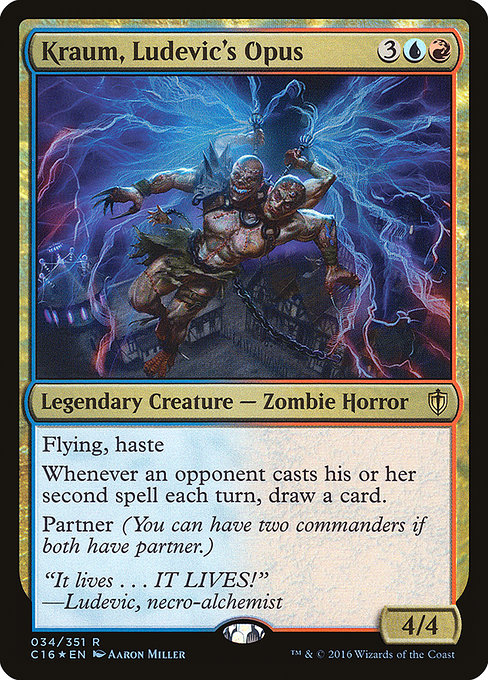
Kraum, Ludevic’s Opus, {3}{U}{R}, 4/4 flying haste. Whenever an opponent casts their second spell each turn, draw a card. Kraum rewards opponents who cast a second spell in a turn. His evasive haste body can deal combat damage for Tymna, but a slow table or removal before the next spell cycle can make five mana a poor investment.
Deploy Tymna when you can connect and pay for cards; deploy Kraum when the table is casting multiple spells and you can still answer a win attempt. Neither partner is an automatic on-curve play.
How you win
Line A: Thassa’s Oracle plus Demonic Consultation. Three mana.
- Cast Thassa’s Oracle for {U}{U} and let it resolve. Do not hold priority. The creature enters the battlefield and only then does its enters trigger go on the stack (CR 608.3a, 603.6a, 603.3). While the Oracle is still a spell, no trigger exists.
- With the trigger on the stack, respond by casting Demonic Consultation for {B}. Name a card that is not in your deck as Consultation resolves.
- Consultation resolves first. It exiles the top six, then reveals cards from the top until it reveals the named card, putting that one in your hand and exiling everything else revealed. The card is not there, so your entire library ends up exiled.
- The Oracle trigger resolves with a library of zero. You win. The Thassa’s Oracle ruling is explicit: if devotion to blue is zero when the trigger resolves and you have no cards in your library, you win the game.
Resolve the Oracle first. Do not hold priority and Consult underneath it. Both orders can win, but they lose very differently. If you Consult while the Oracle is still a spell, a Force of Will or a Mana Drain counters the Oracle with your library already gone, and you lose on your next draw. Resolve it first and a countered Oracle costs you only the Oracle: your library is intact and you try again.
The correct order is not counterproof. In it, Consultation is an ordinary instant cast under the trigger, so any counterspell that can hit it beats the line: Force of Will, Mana Drain, Dispel, Flusterstorm, Swan Song, An Offer You Can’t Refuse, Force of Negation, Fierce Guardianship and Mindbreak Trap all do. Counter the Consultation and the trigger resolves against a full library, which does nothing. Trickbind and Stifle beat it a different way, by countering the trigger. Angel’s Grace is a third thing again: it counters nothing, it just makes the win not happen.
Once the trigger is on the stack, killing the Oracle does not save them. The trigger is an independent object and resolves whether or not the creature is still there. The win clause is “if X is greater than or equal to the number of cards in your library”, and with an empty library that is satisfied at any devotion, because devotion is never negative. Your other blue permanents are irrelevant to it, and so is losing the Oracle’s own {U}{U}. The 2020-01-24 ruling covers only the narrower corner where devotion is actually zero, in which case you also skip looking at cards.
Play it the other way, but read the board first. Against an empty library, removal on the Oracle does nothing and you should not spend it. Against a trigger with cards still in their library it can be exactly right, because devotion then decides the outcome: at devotion 3 against a 2-card library they win, and killing the Oracle in response drops them to devotion 1 and they do not. Count their library before you decide.
Exiling your library does not lose the game on its own. The Demonic Consultation ruling from 2008-10-01 says you lose the next time you are instructed to draw, which may be a draw effect before your next draw step. That is why the trigger has to be on the stack before Consultation resolves.
Tainted Pact makes the full Oracle line cost four mana ({1}{U}{U}{B}). Every card name in this list is unique and there is exactly one basic Island, so you can decline every card to exile the whole library without encountering a repeated name.
Line B: Underworld Breach, Lotus Petal and Grinding Station. Finite self-mill.
Requirements: Underworld Breach and Grinding Station on the battlefield, a reusable zero-mana artifact in the graveyard, six disposable graveyard cards besides it, and {U}{U} available outside the loop. If Oracle is already in the graveyard, do not count it among those six. Oracle must be accessible in the library or graveyard; if it is already in hand, reserve it and hard-cast it instead. This is a conservative sufficient fuel budget, not the minimum for every board state. No effect may prevent casting from the graveyard, artifacts entering, Station activating, or cards reaching the graveyard.
- Escape the artifact, exiling three disposable cards. Its entry triggers Station; let that trigger untap Station.
- Tap Station and sacrifice the artifact to mill yourself three. The artifact returns to the graveyard; a full three-card mill replaces the three exiled cards. This makes no mana.
- Inspect the newly milled cards before another escape. Preserve Oracle and three other cards for its terminal escape; never spend a required piece as fuel. A final mill of only one or two cards reduces the available fuel, which is why the starting reserve matters.
- With the library empty, escape Oracle for {U}{U} and exile three other cards. Let Oracle resolve, then its trigger; an empty library satisfies the win condition at any devotion.
Fuel check: if the first mill finds Oracle and two disposable cards, starting with only three disposable cards leaves just two for the next escape and stalls. Starting with six leaves five disposable cards after protecting Oracle. Subsequent full mills maintain that reserve; a final one-card mill still leaves three. This line is finite, bounded by the library. Taxes add costs to every escape, Rule of Law limits casts, and graveyard hate can stop the engine. Opponents receive priority at the ordinary spell, trigger and ability windows.
Line C: Underworld Breach, Brain Freeze and Storm-Kiln Artist. Finite storm.
Have Breach and Artist on the battlefield, Brain Freeze in the graveyard, {1}{U} to start, at least three disposable graveyard cards, and at least one earlier spell cast this turn. Protect Oracle and its final three-card escape payment separately.
Escape Brain Freeze, exiling three other cards. If N spells preceded it, storm makes N copies and Artist triggers N+1 times from the cast and copies. Resolve the Treasure triggers, then mill yourself with enough copies to replenish fuel. At N=1 that produces two Treasures and can mill six; the two Treasures refund the next {1}{U}. Later casts increase storm and can bank additional Treasures. Copies are not casts and do not themselves increase storm.
The library and escape fuel are finite: update the ledger after each mill, including the last partial mill. Reserve {U}{U} and three disposable cards to escape Oracle. Milling opponents does not immediately make them lose; they must later fail to draw unless another effect wins first. Mayhem Devil deals one damage per actual sacrifice, so total the Treasure sacrifices before claiming lethal. Do not call this arbitrary or infinite damage.
Delney is an engine, not a cute card
Delney, Streetwise Lookout makes eligible triggered abilities of creatures you control with power 2 or less trigger an additional time. Sixteen creatures in this list have relevant native triggers at their printed power. Storm-Kiln Artist, Pollywog Prodigy and Valley Floodcaller can grow out of that range, so check current power. The fifteen besides Artist are Tymna, Thassa’s Oracle, Orcish Bowmasters, Esper Sentinel, Archivist of Oghma, Faerie Mastermind, Lotho, Exhibition Tidecaller, Pollywog Prodigy, Tataru Taru, Valley Floodcaller, Ragavan, Professional Face-Breaker, Voice of Victory and Hexing Squelcher. Tataru’s enters trigger is doubled, but its Secretary ability still triggers only once each turn.
The last three are the ones people miss. Professional Face-Breaker is a 2/3 and its combat-damage trigger makes two Treasures, in a deck whose Line C runs on Treasures. Voice of Victory is a 1/3 and mobilize is a triggered ability, so it makes four attacking Warriors instead of two. Hexing Squelcher is a 2/2 and ward is a triggered ability, so opponents pay the 2 life twice to target it.
The one that matters most: Delney doubles the Thassa’s Oracle trigger. Two separate win triggers on the stack means one Trickbind or one Stifle does not save the table. That alone justifies the slot. A bounce spell was never an answer to the trigger in the first place, with or without Delney, because the trigger resolves independently of the creature.
Three traps:
- Delney does nothing to replacement effects. The official ruling says so directly.
- Delney doubles Lotho’s downside too. Lotho reads “whenever a player casts their second spell each turn, you lose 1 life and create a Treasure token.” A player, not an opponent, so you trigger it yourself, and it is once per player per turn. In a four-player game that is a ceiling of four triggers in a single turn, eight with Delney out, not one per turn cycle. Count it before you cast Ad Nauseam.
- Storm-Kiln Artist stops being doubled the moment you control one artifact, because it gets +1/+0 for each artifact you control and leaves the power 2 or less window immediately. Never build a storm count assuming Delney is doubling Treasures.
Mulligan
Keep: two lands, or one land plus fast mana, plus either a draw engine (Rhystic Study, Mystic Remora, Necropotence, Esper Sentinel) or a tutor plus a free counterspell.
Keep: anything that casts Tymna on turn two or three and holds one piece of interaction.
Ship: five lands and no engine. Ship: one combo half with no way to find the other. Ship: all interaction and no mana engine, because you will run dry while somebody resolves something real.
Mystic Remora improves hands that can capitalize on a spell-heavy table. Decide each upkeep whether the expected cards justify the increasing payment; preserve mana for interaction and development rather than following a fixed payment count.
The interaction suite and how to sequence it
Free: Fierce Guardianship (you control a commander), Force of Will, Force of Negation (only on other players’ turns), Mindbreak Trap (only after an opponent has cast three spells this turn).
One mana, all nine of them: Dispel, Swan Song, Flusterstorm, An Offer You Can’t Refuse, Red Elemental Blast, Silence, Into the Flood Maw, Swords to Plowshares and Chain of Vapor.
Two and up: Mana Drain, Trickbind, Dress Down, and Steal Enchantment when the thing you need gone is somebody’s Rhystic Study or Necropotence.
Sequencing rules that decide games:
- Trickbind has split second and counters a triggered ability. It is your answer to a Thassa’s Oracle trigger already on the stack, while split second stops casting spells and activating nonmana abilities while it is on the stack. Mana abilities, special actions and triggered abilities still function. It can also answer other critical activated or triggered abilities.
- Dress Down beats Thassa’s Oracle only if it resolves first. Flash it in response to the Oracle spell and the Oracle enters with no abilities, so the trigger never happens and the opponent who already exiled their library loses on their next draw. Flash it in response to the trigger and you accomplish nothing, because the trigger exists independently of the creature once it is on the stack. Know which half of the sequence you are looking at before you spend it. Its other jobs: turning off Kinnan, blanking value creatures, shrinking the table’s dorks, and drawing a card.
- An Offer You Can’t Refuse hands them two Treasures. Do not spend it on a cheap spell when those Treasures buy back the real threat. Spend it on the win attempt.
- Spend the worst answer first. Make them beat Swan Song before you spend Force of Will.
Protection on your own turn: Grand Abolisher (opponents cannot cast spells or activate abilities of artifacts, creatures or enchantments during your turn), Voice of Victory (opponents cannot cast spells during your turn), Silence, Ranger-Captain of Eos (sacrifice it, opponents cannot cast noncreature spells this turn), and Hexing Squelcher, which cannot be countered and makes every spell you control uncounterable.
Know the gaps: Grand Abolisher does not stop land abilities, Voice of Victory does not stop activated abilities at all, and neither one stops a Pact of Negation already on the stack.
Threat assessment
Assess visible mana colors, cards, graveyards and known engines together. Oracle/Consultation requires two blue and one black; an apparently empty board can conceal a compact hand-based line, while a permanent-based combo can win with little mana.
In order:
- Can anyone assemble Thassa’s Oracle or a Breach line right now?
- Who has the most cards in hand?
- Who has the fastest mana on the battlefield?
Rhystic Study and Mystic Remora make everyone else’s turn cost more, which drags the table down to your speed. That is the plan. Do not break it by tapping out.
Common mistakes
- Tapping out without checking opponents’ win windows; development is useful when the remaining table can cover a threat or your engine repays the risk.
- Casting Kraum on turn five because you can. He eats a Swords to Plowshares and costs you the turn.
- Failing to communicate Rhystic Study triggers and payments. Resolve missed triggers under the applicable rules or event policy, not a universal “no ask, no card” rule.
- Winning through the only player who was going to counter the other guy.
- Consulting away your library with no Oracle trigger already on the stack. That includes casting the Oracle and holding priority: the trigger does not exist until the Oracle has resolved, so Consulting under the spell empties your library while the Oracle can still be countered.
- Gambling for a single critical piece. Gamble discards a card at random afterward, and if the tutored card is your sole card in hand after the search, it is necessarily discarded. Count the cards remaining after casting Gamble, and prefer a piece you can use from the graveyard or recover if discarded.
Pod notes
Say before shuffling up
This is a Bracket 5 Blue Farm list with both Kraum and Tymna in the command zone. It uses card advantage and stack interaction to support Oracle with Consultation or Pact, plus finite Breach lines. An opponent-turn Oracle attempt needs Borne Upon a Wind. Expect efficient tutors, fast mana and free interaction. I will track escape fuel and announce each priority window. The turn estimates are planning guidance, not results from recorded games.
decks.foiltilt.com/cedh/blue-farm/bracket-5/
State spells, targets, floating mana and trigger counts clearly, and pass priority at each relevant window. Agree on a finite shortcut and its resulting state; another player may interrupt at a specified point. Revealed or drawn cards can change decisions, so do not shortcut conditional hidden-information choices. Choose a numerical X when casting an X spell.
Track Pact and other delayed triggers openly. If something is missed, pause and apply the table’s rules or call the event judge; do not infer intent or invent penalties. The rules allow a player to concede at any time. Agree on considerate concession etiquette before play, and consult a named event’s published policy for tournament procedures.
Bracket references: October 2025 definitions and February 2026 update. Combo timing and shortcuts follow the August 2026 Comprehensive Rules. Turn windows here are untested estimates, not measured win rates.
MTG terms that show up above.
Open glossary
- Game Changer
- A card on Wizards' published Game Changer list. Brackets 4 and 5 have no numerical cap; cEDH play uses the Commander banned list and competitive expectations.
- Bracket
- Wizards' Commander conversation framework: 1 Exhibition, 2 Core, 3 Upgraded, 4 Optimized, 5 cEDH. A stock precon is not automatically a particular bracket. Discuss deck intent, speed, consistency, and play patterns as well as card restrictions.
- Voltron
- The strategy of stacking equipment, auras, and counters onto a single creature (usually the commander) to one-shot opponents through commander damage.
- Commander damage
- A player who has been dealt 21 or more combat damage by the same commander over the game loses. Track each commander separately, including partners. Noncombat damage does not count, and gaining life does not erase this total.
- ETB
- Short for 'enters the battlefield'. Any triggered ability that fires when a permanent enters play is an ETB trigger.
- Equip
- An Equipment's activated ability: pay its equip cost to attach it to a target creature you control. Normally activate only during your main phase with an empty stack and priority. A separate attach effect follows its own timing and restrictions.
- Attach
- The keyword action for putting an Equipment or Aura onto a creature. ETB triggers that attach an equipment for free bypass both the equip cost and the sorcery-speed limit.
- Free equip
- Attaching without paying the printed equip cost. Sigarda's Aid supplies a triggered attach effect. Puresteel Paladin with metalcraft grants equip 0, which still uses normal equip timing unless another effect changes it.
- Treasure
- Sacrificial colorless artifact token. Tap, sacrifice it, add one mana of any color. Counts as an artifact for triggers and metalcraft.
- Phase Out
- A phased-out permanent is treated as though it does not exist, with limited exceptions. Phasing is not a zone change, destruction, or exile. It normally phases in during its controller's untap step, but effects such as Out of Time specify a different duration.
- Cascade
- A cast trigger: exile cards until you exile a nonland card with lower mana value than the cascade spell. You may cast it without paying its mana cost only if the resulting spell also has lower mana value. Put the other exiled cards on the bottom in a random order.
- Affinity
- A cost-reduction keyword. 'Affinity for artifacts' means the spell costs 1 less to cast for each artifact you control.
- Modified
- A creature is modified if it has a counter, is equipped, or is enchanted by an Aura controlled by that creature's controller. The Equipment's controller does not matter; the Aura's controller does.
- Vigilance
- Attacking does not cause a creature with vigilance to tap. It still needs to be untapped and otherwise eligible to attack. Brave the Sands grants vigilance; Shadowspear grants trample and lifelink instead.
- Lifelink
- Damage dealt by a source with lifelink also causes its controller to gain that much life at the same time. Shadowspear grants lifelink. Vampiric Link instead uses a triggered life-gain ability that resolves later and is not lifelink.
- Mindslaver
- A 'Mindslaver effect' lets you control an opponent's next turn: their draws, plays, and attacks. Named for the Mindslaver artifact; some commander-specific triggers replicate the effect.
- Metalcraft
- An ability word marking effects that care whether you control three or more artifacts. Read the individual card: metalcraft is not itself an activated ability or a shared rules ability.
- Impulse draw
- Exile cards with permission to play or cast them for a stated duration. Follow the effect's exact timing, land-play, and cost restrictions.
- Mulligan
- Under the London mulligan, shuffle and draw seven each time, then put cards on the bottom after choosing to keep. In multiplayer Commander the first mulligan is free; a keep after the second mulligan puts one card back, the third puts two back, and so on.
- Drain
- A trigger that makes an opponent lose life and gains you that much, Blood Artist style. Life loss is not damage, so it goes through protection and prevention that only stop damage.
- Rule-zero
- The pre-game conversation about deck power, combos, tutors and table expectations, held before the first shuffle so nobody is surprised by what the deck does.
- Summoning sickness
- A creature cannot attack, and cannot activate an ability with the tap or untap symbol in its cost, unless it has been under its controller's control continuously since their most recent turn began (CR 302.6). Haste turns it off, and it never applies to other permanent types.
- Replacement effect
- A continuous effect that watches for an event and replaces it with a different one as it happens, rather than triggering afterwards (CR 614.1). When several would apply to the same event, the affected object's controller or the affected player picks the order (CR 616.1).
- Storm
- A triggered ability that functions on the stack: when you cast the spell, copy it for each other spell cast before it this turn (CR 702.40a). The copies are not cast, so they never add to the storm count themselves.
- Mana Vault
- A one-mana artifact that taps for three colorless mana and does not untap during your untap step. Its upkeep trigger lets you pay {4} to untap it. Its draw-step trigger deals 1 damage to you if it is still tapped; paying or declining the upkeep cost is not itself the damage condition.
All 100 cards.
Kraum and Tymna cEDH ritual-storm guide with finite Breach/LED fuel accounting, Oracle backup, protection and recovery decisions.
Chatterfang cEDH guide: seeded sacrifice engines, life and draw limits, Aluren/Acererak dungeon wins, tutors and disruption.
Kinnan cEDH guide: Basalt colorless mana, Thrasios conversion, colored payoff requirements, protection and common stax interactions.
Custom builds, cEDH lists and stock precons, filtered by colour, bracket or commander.