
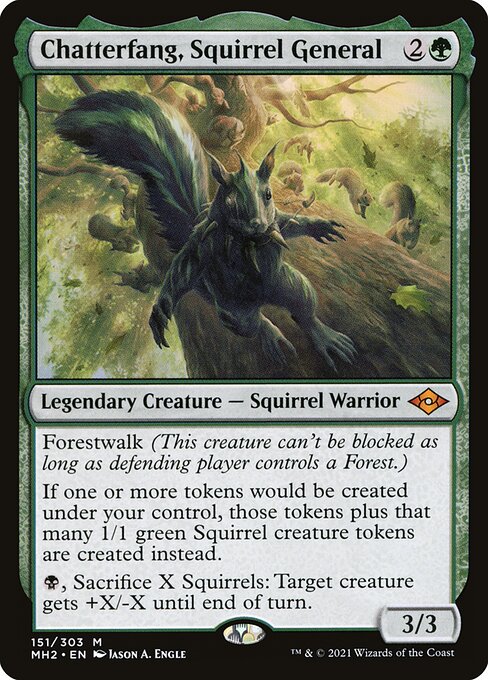
CHATTERFANG cEDH. seed, sacrifice, account for the payoff.
Build a seeded sacrifice engine with a drain payoff, or use Aluren and Acererak for a commander-independent dungeon win.
At the table
Pod notes →- Keep
- Green acceleration, black access, and a tutor or draw engine. Commander plus one piece is not a complete kill without seed fodder and the relevant payoff.
- Develop
- Create a seed Squirrel and protect the commander. Keep a rebuild or commander-independent Aluren/Acererak route in mind.
- Finish
- One Squirrel, initial B, Chatterfang and Plunderer repeat deaths at net zero; a drain payoff wins. Two Squirrels bank a Treasure per cycle. Aluren/Acererak repeatedly ventures through Lost Mine.
- Watch out
- Soultrader costs life; Yawgmoth and Skullclamp require library room. Do not complete Tomb with Acererak. Aluren is symmetrical and does not waive commander tax.
Guide reviewed List 979b3acb
Rules and list review, not a playtest record. Turn windows and matchup advice are estimates. The list reference covers card quantities and the command zone; card changes require another guide and pod-note review.
Rules basis: Magic Comprehensive Rules, August 19, 2026. Bracket basis: Wizards’ October 2025 update and February 2026 follow-up.
Bracket 5 Golgari creature combo with tutors and disruptive permanents.
Full gameplan
Chatterfang supports token engines, while Aluren/Acererak can finish independently of the commander.
Opening hands
Seven cards from this build. Commanders start in the command zone. In multiplayer Commander, the first mulligan is free. For later mulligans, draw seven again; once you keep, put one card on the bottom for each mulligan beyond the free one.
KeepShow the seven
- Bayou
- Command Tower
- Elvish Mystic
- Demonic Tutor
- Skullclamp
- Veil of Summer
- Zulaport Cutthroat
Two colored lands plus a turn-one dork support the commander and tutor. Skullclamp offers a card route once fodder exists, Zulaport is a payoff, and Veil can cover an attempt. Do not confuse having the payoff with already having a seeded loop.
BorderlineShow the seven
- Forest
- Elvish Mystic
- Worldly Tutor
- Pitiless Plunderer
- Zulaport Cutthroat
- Blood Artist
- Reanimate
Only green mana is available and there is no seeded loop. Mystic helps development but the black cards require another source, while Worldly Tutor puts a creature on top rather than in hand. Usually take the free mulligan at seven; it is a riskier later-mulligan consideration.
MulliganShow the seven
- Command Tower
- Pitiless Plunderer
- Warren Soultrader
- Aluren
- Acererak the Archlich
- Yawgmoth, Thran Physician
- Zulaport Cutthroat
The hand contains several win pieces but only one land and no acceleration or draw engine. Neither Aluren nor a seeded Chatterfang line is funded. Look for mana development rather than keeping the names of a combo.
Chatterfang, Squirrel General strategy guide
What this deck is
This is the Bracket 5 build, distinct from Squirreled Away at Bracket 4. Tutors find creature engines, and token production supplies sacrificial bodies. Most Chatterfang routes require more than one partner card: a seed creature, initial mana or life, and a payoff all matter.
Protect a complete attempt rather than exposing half the engine without recovery. Aluren with Acererak is a separate win route that does not need Chatterfang. The list uses Veils and disruptive creatures instead of a blue counterspell suite; opposing spells and activated abilities still create interaction windows.
The commander
Chatterfang, Squirrel General, {2}{G}, 3/3.
- Forestwalk.
- If one or more tokens would be created under your control, those tokens plus that many 1/1 green Squirrel creature tokens are created instead.
- {B}, Sacrifice X Squirrels: Target creature gets +X/-X until end of turn.
Three things people get wrong about him:
- The doubling covers every token type, not just creatures. The official ruling names Clue, Food and Treasure specifically. Every Treasure you make comes with a Squirrel.
- You do not have to be the one making the token. The 2025-01-24 ruling says the replacement applies as long as the tokens are created under your control, no matter who controls the spell or ability.
- The third ability is a sacrifice outlet, and that is what it is for. Removal is the secondary use. It is a mana-positive sacrifice outlet in the right board state.
Forestwalk is not a throwaway. Yavimaya, Cradle of Growth makes every land a Forest, including your opponents’ lands, which makes Chatterfang unblockable at the whole table. Several cEDH mana bases run Tropical Island and Breeding Pool, which already have the Forest type on their own.
How you win
Line A: Chatterfang plus Pitiless Plunderer. Seeded death loop.
Start with both creatures on the battlefield, one Squirrel and one black mana. A creature sacrificed to Phyrexian Tower with Plunderer present can supply a Treasure, a Chatterfang Squirrel and the starting black mana. You cannot begin from only the two named creatures and no expendable body.
- Choose a creature target, pay {B} and sacrifice one Squirrel to Chatterfang. You may target the same Squirrel you are about to sacrifice: targets are chosen before costs. The ability then has no legal target on resolution, but the sacrifice and Plunderer trigger still occurred.
- Resolve Plunderer to create a Treasure and, through Chatterfang, a replacement Squirrel.
- Sacrifice the Treasure for the black mana to repeat. One Squirrel is restored; net mana is zero.
Zulaport Cutthroat drains each opponent and gains you life per death. Blood Artist targets one player per death and gains you life, so allocate enough repetitions across opponents. Marionette Apprentice sees both the other creature and your Treasure go to the graveyard. Declare a finite sufficient number of repetitions and allow interruption.
Two-Squirrel mana version: start with two Squirrels and {B}; sacrifice both with X=2. The two Plunderer triggers create two Treasures and two replacement Squirrels. Spend one Treasure for the next {B}, banking one Treasure per cycle. This is mana-positive. Using a sacrificed Squirrel as the target avoids progressively shrinking an engine creature. If using the ability as removal instead, choose a legal surviving target and track its changing toughness.
Line B: Chatterfang plus Warren Soultrader. Life-funded Treasures.
Warren Soultrader reads “Pay 1 life, Sacrifice another creature: Create a Treasure token.” Start with an expendable creature or Squirrel and sufficient life. With Chatterfang the Treasure comes with a Squirrel, so each later sacrifice replaces the Squirrel. Net: plus one Treasure, minus one life. Without life replacement the sequence is finite; paying your last life loses before a gain trigger can rescue you.
Add Zulaport Cutthroat or Blood Artist and you gain the life back on each death. With at least two life before the first payment and each gain resolving, the cycle is life-neutral and can produce an arbitrarily large declared finite amount of mana and drain. Blood Artist must target an opponent for its drain, whereas Zulaport hits all opponents.
This is the line Aluren deploys for free. Chatterfang is mana value 3, Warren Soultrader is 3, Zulaport Cutthroat is 2, so with Aluren out all three can be cast at instant speed without paying their mana costs.
One exception, and it is your commander. Aluren waives the mana cost only. Commander tax is an additional {2} for each previous cast from the command zone (CR 903.8), and additional costs are still paid when you cast without paying the mana cost. So a recast Chatterfang costs {2}, then {4}, then {6} even under Aluren. Free the first time, never again.
Line C: Chatterfang plus Pitiless Plunderer plus Skullclamp. Library-limited draw.
Start with one unbuffed 1/1 Squirrel and one mana for the first equip. An anthem that raises its toughness can stop this line.
- Equip Skullclamp to a 1/1 Squirrel for {1}. It becomes 2/0 and dies as a state-based action.
- Skullclamp: draw two cards. Pitiless Plunderer: create a Treasure, doubled by Chatterfang into a Treasure plus a Squirrel.
- Sacrifice the Treasure to pay the next equip.
Net per iteration: two cards, no mana, no creatures lost. Each trigger draws two mandatory cards; stop with enough library to resolve the next trigger safely. Drawing two with only one card left attempts a draw from an empty library, causing a loss when state-based actions are checked after resolution. Find and fund Line A or B before proceeding.
Equip is sorcery speed, so this loop only runs on your own turn. Lines A, B and D are all instant speed and can be done on an opponent’s end step. This one cannot.
Line D: Yawgmoth, Thran Physician plus Chatterfang plus Pitiless Plunderer.
Yawgmoth reads “Pay 1 life, Sacrifice another creature: Put a -1/-1 counter on up to one target creature and draw a card.” Sacrifice a Squirrel, Plunderer makes a Treasure plus a Squirrel, you draw. One life and one card per iteration, and the Treasure pile grows. Zulaport or Blood Artist can replace the life, but the mandatory draw still limits the sequence to available library. Begin with enough life to pay safely and a seed creature.
Hapatra, Vizier of Poisons replaces Pitiless Plunderer here. Yawgmoth puts a -1/-1 counter on something, Hapatra makes a Snake, Chatterfang makes it a Snake plus a Squirrel. The -1/-1 counter must actually be placed on a legal creature to trigger Hapatra. Repeatedly shrinking a key creature can kill it; targeting sacrificial fodder may be safer. This still spends life and draws mandatory cards, so it is not an unlimited draw engine.
Line E: Aluren plus Acererak the Archlich. Repeatable dungeon drain.
Have Aluren on the battlefield, Acererak in hand, and Tomb of Annihilation not completed. Chatterfang is not required. Aluren allows Acererak to be cast without paying its mana cost and at instant timing. Resolve Acererak’s entry trigger: return him to hand and venture. Choose Lost Mine of Phandelver, not Tomb.
Follow Cave Entrance (scry) → Mine Tunnels (Treasure) or Goblin Lair → Dark Pool (each opponent loses 1 and you gain 1) → Temple of Dumathoin (draw). Completing Lost Mine does not switch off Acererak, so repeat a finite number of runs sufficient for lethal. For the straightforward route resolving every room trigger, count the mandatory Temple draws against your library.
Advanced route with a short library: while Temple’s draw trigger is pending, recast Acererak using Aluren’s instant-timing permission. Its next venture leaves the bottommost room and enters a new Lost Mine (CR 309.5b, 701.49c). Continue new drain cycles above the pending draw triggers, and win before those draws resolve. Explain the stack and declared drain count; if the attempt is interrupted, the pending draws remain a risk. Opponents can respond to creature spells and triggers.
Aluren is symmetrical: opponents can also cast creatures with mana value three or less for free, including Oracle. Commander tax is still an additional cost. Do not complete Tomb: doing so prevents Acererak’s return-and-venture trigger in later entries.
Mulligan
Keep: any hand with a turn-one mana dork, a land, and a black source. This deck is built to deploy Chatterfang on turn two.
Keep: a tutor plus the mana to cast it plus a follow-up. Fourteen nonland cards search your own library (seven fetchlands and Prismatic Vista search too, which matters against Opposition Agent but not for this keep decision): Vampiric Tutor, Demonic Tutor, Imperial Seal, Worldly Tutor, Entomb, Diabolic Intent, Crop Rotation, Survival of the Fittest, Green Sun’s Zenith, Chord of Calling, Finale of Devastation, Eldritch Evolution, Fiend Artisan and Wishclaw Talisman. One tutor is one combo piece.
Two of those are easy to overlook. Entomb puts the card in the graveyard rather than your hand, which is the point in a deck running Reanimate and Yawgmoth’s Will. Crop Rotation finds Gaea’s Cradle or Phyrexian Tower at instant speed for {G} plus sacrificing a land, which is a combo piece in this deck and not just a land. Count the sacrificed land when you decide whether a two-land hand functions.
Praetor’s Grasp is not on that list. It searches target opponent’s library. It is a hoser, not a tutor, and it can never find your own piece.
Ship: no green source. Ship: three or more lands and no acceleration. Ship: Ad Nauseam with nothing to cast off it.
The pieces that do not combo, and why they are there
- Allosaurus Shepherd and Destiny Spinner: green spells you control cannot be countered, and creature and enchantment spells cannot be countered, respectively. They are how a deck with no counterspells resolves a combo into two blue opponents.
- Veil of Summer and Autumn’s Veil: one mana to beat blue and black counterspells and targeted removal for a turn. Veil of Summer is the broad one: hexproof from blue and black for you and your permanents, spells uncounterable, and it replaces itself. Autumn’s Veil is narrower than people assume: it stops countering only by blue or black spells, not by abilities, and it protects only creatures you control from being targeted.
- Endurance: flash, and puts a target player’s graveyard on the bottom of their library. This is your answer to Underworld Breach and Yawgmoth’s Will. Evoke it for free by exiling a green card if you have to.
- Dauthi Voidwalker: cards that would go to an opponent’s graveyard get exiled with a void counter instead, and you can cash it in to play one of them free. Against a Breach deck this prevents new graveyard fuel while it remains on the battlefield, but does not remove cards already there and can itself be answered.
- Opposition Agent: you control opponents while they search, and they exile what they find. Know the limit: Demonic Consultation and Tainted Pact do not search. They exile from the top of the library. Opposition Agent stops fetchlands, Vampiric Tutor, Demonic Tutor, Gamble, Intuition and Gifts Ungiven, and does nothing to a Consultation.
- Culling Ritual: destroys every nonland permanent with mana value 2 or less and pays you for each one. It kills your own dorks, so it is a reset button for a stax board, not a value play. Chatterfang at mana value 3 survives it.
- Gaea’s Cradle: taps for {G} per creature you control. A board of Squirrels turns it into substantial green mana; losing those creatures also removes that output.
The tutor risk nobody talks about
This deck runs Demonic Consultation and Tainted Pact with no Thassa’s Oracle, because there is no blue. They are tutors here, nothing more.
- Demonic Consultation: if the card you name is in the top six, you exile your entire library. The 2008-10-01 ruling confirms you do not lose right then, you lose the next time you would draw. A shuffled library gives you no reliable knowledge that a card is deep. Verify the named card remains in the library and accept the top-six risk; choose a conventional tutor when a failed Consultation would lose the game.
- Tainted Pact: unique names prevent an accidental duplicate-name stop, but every declined card is exiled. Take the needed card deliberately and preserve a viable win path; it is not a risk-free tutor.
Threat assessment
You are the deck that cannot counter anything, so your interaction has to be pre-emptive. Deploy Dauthi Voidwalker and Opposition Agent on your own terms rather than holding them for a moment that requires you to have mana open. Endurance is the exception and should be held: it has flash, and evoke lets you cast it for free by exiling a green card, so it can disrupt a Breach turn at instant speed. Opposition Agent also has flash and can punish a search when you can pay for it.
Priority order against a blue pod:
- Clear their graveyard with Endurance or prevent new graveyard fuel with Dauthi Voidwalker.
- Tax or stop their tutors (Opposition Agent).
- Hold Veil of Summer for your own win attempt, not for their value spell.
Common mistakes
- Activating Chatterfang’s third ability for a large X as removal when the same mana loops for free with Pitiless Plunderer out. Check the loop first.
- Resolving Aluren into two untapped blue opponents.
- Sacrificing Acererak to a sacrifice outlet in response to his own trigger. You still venture (the ruling allows it), but he is in the graveyard and Aluren cannot recast him.
- Casting Culling Ritual with your own combo on the board.
- Forgetting that every token you make comes with a Squirrel alongside it. The Squirrel is the extra body that matters for Gaea’s Cradle, Skullclamp and Chatterfang’s own activation cost. The original token keeps its own types: a Treasure made under Chatterfang is still just an artifact, is not a creature, and cannot be sacrificed to “Sacrifice X Squirrels”.
- Treating an unknown shuffled library as though you know the desired card is below the top six for Consultation.
Pod notes
Say before shuffling up
This is Bracket 5 Golgari creature combo. Chatterfang, sacrifice engines and drain payoffs support repeatable death loops, and Aluren with Acererak offers a commander-independent dungeon win. The list uses tutors, fast mana and disruptive creatures; it is not a stock Squirrel precon. Aluren also lets opponents cast small creatures for free. I will identify seed tokens, life costs and draw limits before proposing a finite shortcut, and explain exactly which dungeon and rooms I am using.
decks.foiltilt.com/cedh/chatterfang-cedh/bracket-5/
State spells, targets, floating mana and trigger counts clearly, and pass priority at each relevant window. Agree on a finite shortcut and its resulting state; another player may interrupt at a specified point. Revealed or drawn cards can change decisions, so do not shortcut conditional hidden-information choices. Choose a numerical X when casting an X spell.
Track Pact and other delayed triggers openly. If something is missed, pause and apply the table’s rules or call the event judge; do not infer intent or invent penalties. The rules allow a player to concede at any time. Agree on considerate concession etiquette before play, and consult a named event’s published policy for tournament procedures.
Bracket references: October 2025 definitions and February 2026 update. Combo timing and shortcuts follow the August 2026 Comprehensive Rules. Turn windows here are untested estimates, not measured win rates.
MTG terms that show up above.
Open glossary
- Game Changer
- A card on Wizards' published Game Changer list. Brackets 4 and 5 have no numerical cap; cEDH play uses the Commander banned list and competitive expectations.
- Bracket
- Wizards' Commander conversation framework: 1 Exhibition, 2 Core, 3 Upgraded, 4 Optimized, 5 cEDH. A stock precon is not automatically a particular bracket. Discuss deck intent, speed, consistency, and play patterns as well as card restrictions.
- Voltron
- The strategy of stacking equipment, auras, and counters onto a single creature (usually the commander) to one-shot opponents through commander damage.
- Commander damage
- A player who has been dealt 21 or more combat damage by the same commander over the game loses. Track each commander separately, including partners. Noncombat damage does not count, and gaining life does not erase this total.
- ETB
- Short for 'enters the battlefield'. Any triggered ability that fires when a permanent enters play is an ETB trigger.
- Equip
- An Equipment's activated ability: pay its equip cost to attach it to a target creature you control. Normally activate only during your main phase with an empty stack and priority. A separate attach effect follows its own timing and restrictions.
- Attach
- The keyword action for putting an Equipment or Aura onto a creature. ETB triggers that attach an equipment for free bypass both the equip cost and the sorcery-speed limit.
- Free equip
- Attaching without paying the printed equip cost. Sigarda's Aid supplies a triggered attach effect. Puresteel Paladin with metalcraft grants equip 0, which still uses normal equip timing unless another effect changes it.
- Treasure
- Sacrificial colorless artifact token. Tap, sacrifice it, add one mana of any color. Counts as an artifact for triggers and metalcraft.
- Phase Out
- A phased-out permanent is treated as though it does not exist, with limited exceptions. Phasing is not a zone change, destruction, or exile. It normally phases in during its controller's untap step, but effects such as Out of Time specify a different duration.
- Cascade
- A cast trigger: exile cards until you exile a nonland card with lower mana value than the cascade spell. You may cast it without paying its mana cost only if the resulting spell also has lower mana value. Put the other exiled cards on the bottom in a random order.
- Affinity
- A cost-reduction keyword. 'Affinity for artifacts' means the spell costs 1 less to cast for each artifact you control.
- Modified
- A creature is modified if it has a counter, is equipped, or is enchanted by an Aura controlled by that creature's controller. The Equipment's controller does not matter; the Aura's controller does.
- Vigilance
- Attacking does not cause a creature with vigilance to tap. It still needs to be untapped and otherwise eligible to attack. Brave the Sands grants vigilance; Shadowspear grants trample and lifelink instead.
- Lifelink
- Damage dealt by a source with lifelink also causes its controller to gain that much life at the same time. Shadowspear grants lifelink. Vampiric Link instead uses a triggered life-gain ability that resolves later and is not lifelink.
- Mindslaver
- A 'Mindslaver effect' lets you control an opponent's next turn: their draws, plays, and attacks. Named for the Mindslaver artifact; some commander-specific triggers replicate the effect.
- Metalcraft
- An ability word marking effects that care whether you control three or more artifacts. Read the individual card: metalcraft is not itself an activated ability or a shared rules ability.
- Impulse draw
- Exile cards with permission to play or cast them for a stated duration. Follow the effect's exact timing, land-play, and cost restrictions.
- Mulligan
- Under the London mulligan, shuffle and draw seven each time, then put cards on the bottom after choosing to keep. In multiplayer Commander the first mulligan is free; a keep after the second mulligan puts one card back, the third puts two back, and so on.
- Drain
- A trigger that makes an opponent lose life and gains you that much, Blood Artist style. Life loss is not damage, so it goes through protection and prevention that only stop damage.
- Rule-zero
- The pre-game conversation about deck power, combos, tutors and table expectations, held before the first shuffle so nobody is surprised by what the deck does.
- Summoning sickness
- A creature cannot attack, and cannot activate an ability with the tap or untap symbol in its cost, unless it has been under its controller's control continuously since their most recent turn began (CR 302.6). Haste turns it off, and it never applies to other permanent types.
- Replacement effect
- A continuous effect that watches for an event and replaces it with a different one as it happens, rather than triggering afterwards (CR 614.1). When several would apply to the same event, the affected object's controller or the affected player picks the order (CR 616.1).
- Storm
- A triggered ability that functions on the stack: when you cast the spell, copy it for each other spell cast before it this turn (CR 702.40a). The copies are not cast, so they never add to the storm count themselves.
- Mana Vault
- A one-mana artifact that taps for three colorless mana and does not untap during your untap step. Its upkeep trigger lets you pay {4} to untap it. Its draw-step trigger deals 1 damage to you if it is still tapped; paying or declining the upkeep cost is not itself the damage condition.
All 100 cards.
Kinnan cEDH guide: Basalt colorless mana, Thrasios conversion, colored payoff requirements, protection and common stax interactions.
Blue Farm cEDH pilot guide: Kraum and Tymna card advantage, Oracle sequencing, Borne Upon a Wind timing, and finite Breach fuel accounting.
Kraum and Tymna cEDH ritual-storm guide with finite Breach/LED fuel accounting, Oracle backup, protection and recovery decisions.
Custom builds, cEDH lists and stock precons, filtered by colour, bracket or commander.